

Severe vitamin D deficiency may be a major, treatable contributor to chronic disease and early death. That is the central message of our new study in Aging Cell.
To investigate the health consequences of vitamin D deficiency, we examined medical records from two large populations: members of Leumit Health Services in Israel and patients in the US TriNetX research network.
We compared adults with severe vitamin D deficiency with adults who had sufficient levels, carefully matching the groups for age, sex, and other important health characteristics. These comparisons included nearly 25,000 people in Israel and more than 446,000 in the United States. We then tracked illness and mortality in their medical records over follow-up periods of up to ten years.
In the Israeli cohort, people with severe deficiency had approximately 2.6 times the risk of dying during follow-up compared with similar people whose vitamin D levels were sufficient. In an independent population in the United States, the risk was approximately 60% higher. These findings persisted after accounting for measured differences in age, medical conditions, and other risk factors.
The associations extended across multiple diseases and organ systems. The risk of developing kidney failure requiring dialysis was approximately doubled in both populations. In Israel, the risk of a foot or toe amputation was approximately 3.6 times as high. Severe deficiency was also associated with heart attacks, strokes, dementia, and damage to the retina from diabetes.
These findings suggest that vitamin D importance may extend much further beyond bone health.
We also investigated whether supplementation might reduce these risks. In a separate analysis of nearly 248,000 adults, vitamin D supplement use was associated with lower risks of death, diabetes, and heart attack. Among those whose supplements were predicted to raise blood vitamin D levels the most, mortality was approximately 28% lower than among people with little or no recorded supplementation.
We then applied a causal-inference framework to account more carefully for measured differences between patients and for treatment decisions over time. The association persisted and became stronger: approximately 35% lower mortality in the same supplementation category.
The combination matters. Severe deficiency was associated with substantial health risks in two independent populations, and supplementation was associated with better outcomes even after additional efforts to address alternative explanations.
A deficiency that can usually be corrected with an inexpensive supplement deserves particular attention when the potential consequences include death, kidney failure, and disabling complications. If correcting it accounts for even part of the differences we observed, the implications for preventive medicine could be substantial.
As a family physician and epidemiologist, I believe these findings make a strong case for identifying and treating vitamin D deficiency, particularly in older adults and people at high risk of persistent deficiency.
The same pattern in two countries
We defined severe deficiency as a vitamin D level below 10 ng/mL and used levels above 30 ng/mL as the sufficient comparison group. In Israel, the values were adjusted to their estimated winter low; in the US analysis, we used the measured levels.
The figure below compares four major health outcomes across the two populations.
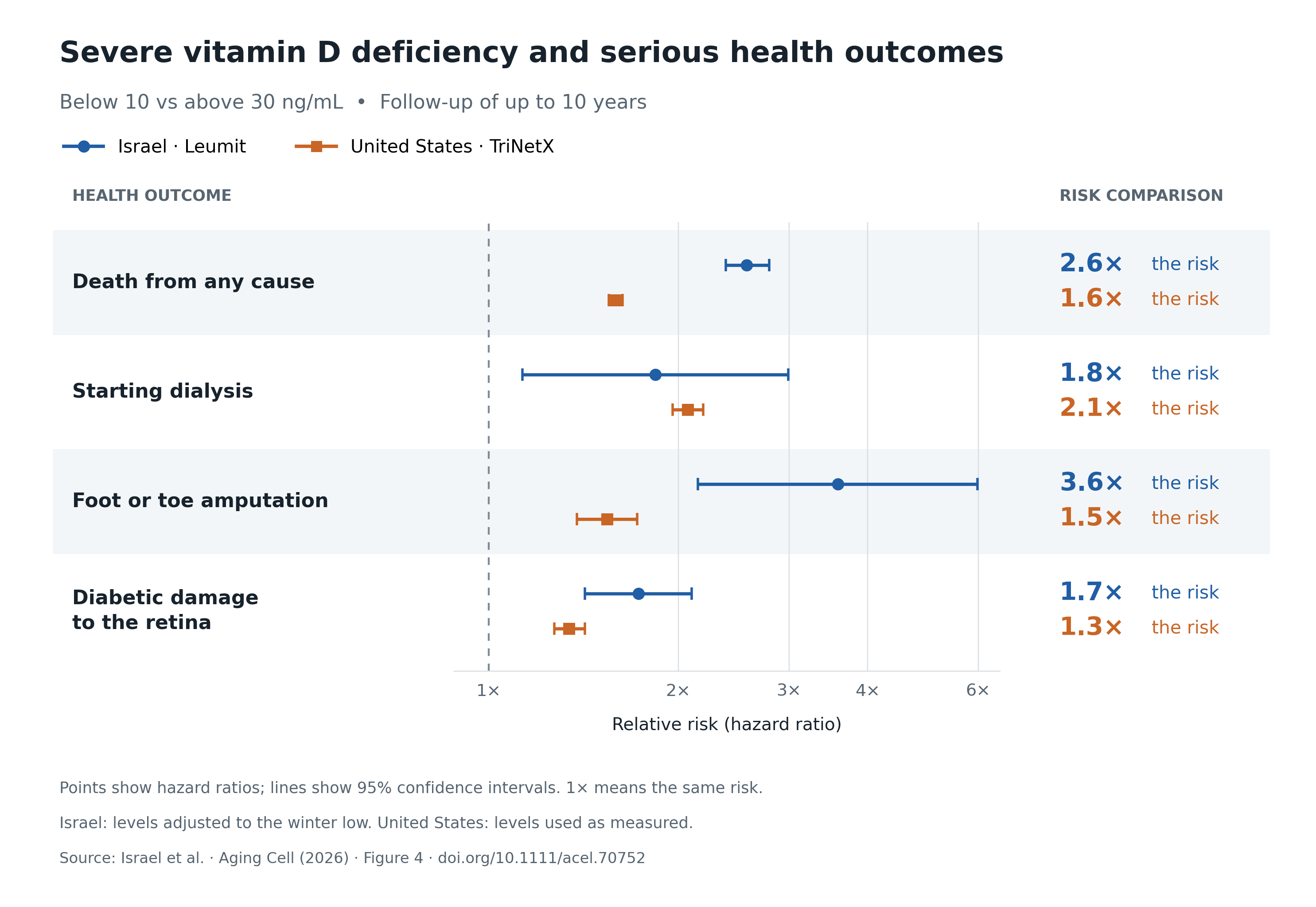
Severe vitamin D deficiency was associated with higher risks of death and serious illness in both populations. The figure compares levels below 10 with levels above 30 ng/mL during follow-up of up to ten years. Points show the estimated relative risks; horizontal lines show their uncertainty, expressed as 95% confidence intervals.
The size of the associations differed between countries. Their consistent direction across several organs made them more compelling.
We also looked beyond extreme deficiency. In a separate analysis of nearly 248,000 Israeli adults, starting levels of 15–20 ng/mL were associated with 6% higher mortality, 11% higher diabetes risk, and 16% higher heart attack risk than levels above 20. Lower starting levels generally went with higher risks, and the pattern extended beyond severe deficiency.
Following supplement use over time
A difficult question remains: could low vitamin D simply be a consequence of poor health?
Someone who is unwell may spend less time outdoors. Illness can change diet, activity, and medical treatment. Those differences could contribute to an association between low vitamin D and later disease.
To investigate whether the risks might be modifiable, we turned to pharmacy records.
Among nearly 248,000 Leumit members aged 30 and older, we followed purchases of vitamin D supplements over time. Using those purchases together with laboratory results, we estimated how much the supplements contributed to blood vitamin D levels. The analysis tracked changes in supplementation during follow-up and accounted separately for the starting vitamin D level.
Greater supplementation was associated with lower mortality. For people whose supplements were predicted to raise blood levels the most, the risk was approximately 28% lower than among people with little or no recorded supplementation. Supplement use was also associated with lower risks of diabetes and heart attack.
That is encouraging, but people choose to take supplements for reasons that may themselves be related to health.
We therefore used a causal-inference framework: statistical methods designed to make comparisons more informative about cause and effect. These methods accounted for measured medical differences and for the way treatment decisions changed over time.
The mortality finding persisted. In this analysis, the same supplementation category was associated with approximately 35% lower mortality.
We also repeated analyses after setting aside events occurring during the first year or even the first two years after the initial test. The principal findings remained similar, making it less likely that they reflected only an illness already developing when vitamin D was measured.
Together, these checks strengthen the case for a protective effect. They cannot account for every unrecorded difference between patients, and a pharmacy purchase cannot confirm that every dose was taken.
Who stands to gain most
A relative reduction in risk can mean very different things for different people.
If someone’s risk of dying over the next ten years is already low, even a substantial relative reduction translates into a small absolute benefit. For an older person at much higher risk, the potential benefit can be considerably larger.
We used the study’s models to estimate that difference.
For adults aged 70 and older whose starting vitamin D level was below 5 ng/mL, the model projected that treating approximately ten people over ten years could correspond to one fewer death.
This estimate assumes that supplementation itself accounts for the lower mortality we observed. It gives a sense of the potential importance of treating profound deficiency in older adults.
The projections also suggested a potential benefit at less extreme levels. Among adults aged 70 and older starting at 15–20 ng/mL, the estimated number needed to treat over ten years ranged from approximately 18 to 28, depending on the supplementation level.
These estimates help identify where the greatest absolute gains might lie: among people whose deficiency and underlying health risks leave them most vulnerable.
Making sense of the clinical trials
Readers familiar with vitamin D research may have heard about large trials that did not identify benefit from supplementation.
Those results matter. Understanding them requires looking at whom the trials enrolled and what question they tested.
In the large VITAL trial, for example, vitamin D supplementation did not significantly reduce the main outcomes of invasive cancer or major cardiovascular events. Among participants whose baseline blood samples were analyzed, the average vitamin D level was approximately 31 ng/mL; about 13% had levels below 20.
That is a very different starting population from one selected for severe deficiency.
A trial enrolling many people who already have adequate vitamin D largely measures what happens when additional vitamin D is offered to that population. A study focused on people with substantial deficiency asks how much might be gained by correcting a shortfall.
Starting levels are therefore important, as are adherence, supplement use in comparison groups, and the blood levels actually achieved during treatment.
These factors are plausible explanations for some of the differences between studies. Our findings support testing them directly in trials designed around deficient populations, particularly older adults. They also argue for taking documented deficiency seriously while that research continues.
Why the findings extend beyond bones
Vitamin D is best known for its role in calcium absorption and bone health. Its biological activity is much broader.
Many tissues have vitamin D receptors. Vitamin D participates in immune regulation, inflammatory responses, and the behavior of cells throughout the body. This provides a plausible reason why deficiency might be associated with problems involving several organs.
Our study did not establish the mechanism connecting vitamin D with each outcome. It raises the possibility that a sustained deficiency affects shared processes that help the body cope with disease over time.
That is why the breadth of the findings interests me. Heart disease, kidney failure, dementia, and diabetes complications are usually considered separately. A common, potentially correctable factor associated with several of them deserves serious attention.
A sunny country can still have a deficiency problem
Our skin produces vitamin D when exposed to certain wavelengths of sunlight. But living somewhere sunny does not guarantee that enough of that light reaches the skin.
Using medical records from Leumit Health Services, we analyzed more than 1.67 million vitamin D measurements from approximately 468,500 adults in Israel. The seasonal pattern was unmistakable: levels peaked near the end of August and reached their lowest point around February.
To compare people tested in different months, we developed a model that translated each result into an estimated level at the winter low. This put a blood test taken in July and one taken in January on the same seasonal scale.
Among the Leumit members who had been tested, the estimated winter levels were below 10 ng/mL in about one in ten men and one in five women. That is the range we classified as severe deficiency. Approximately two-thirds had estimated winter levels below 20 ng/mL.
A summer test can therefore offer reassurance that does not last through winter. The date helps us understand how much reassurance the result should provide.
For readers whose laboratory reports use nmol/L: 10 ng/mL equals 25 nmol/L, and 20 ng/mL equals 50 nmol/L.
Putting the findings to use
My practical message is to take a known vitamin D deficiency seriously and make a plan to correct it. Regular supplementation offers a straightforward way to restore vitamin D when sunlight and diet are insufficient.
This deserves particular attention in people who spend most of their time indoors, older adults, people with darker skin, and people living with obesity.
In Israel, this includes many women in ultra-Orthodox Jewish and Arab communities whose clothing and head coverings leave very little skin exposed to sunlight. Identifying deficiency and offering accessible treatment are especially important in these populations. A supplement offers a practical way to correct the shortfall.
Winter makes this more pressing. If you rely on summer sunshine to maintain your vitamin D, consider what happens during the months when that source declines.
Vitamin D is inexpensive and generally safe at appropriate doses. Treating substantial deficiency can require a different regimen from maintaining an adequate level; your clinician can help choose the dose. Excessive doses can raise blood calcium, so the aim is consistent, appropriate supplementation.
Will your vitamin D level be sufficient this winter?
If you already have a vitamin D blood test, you can use our calculator to estimate your winter low. Enter the date of your test and the measured level. The calculator uses a model developed at the Leumit Research Institute and help you understand whether you may be at risk of deficiency.
Calculate your estimated winter vitamin D level →

Our findings suggest that correcting vitamin D deficiency could have consequences for health far beyond the skeleton. The potential gains appear especially important in older adults with the deepest deficiencies. Identifying these patients and helping them maintain adequate vitamin D levels is an achievable step in preventive care, with the potential to reduce serious illness and premature death.
Sources
Israel A, et al. Vitamin D Deficiency, Supplementation, and Aging-Related Morbidity and Mortality Across Two Longitudinal Population Cohorts. Aging Cell, 2026.
Manson JE, et al. Vitamin D Supplements and Prevention of Cancer and Cardiovascular Disease. New England Journal of Medicine, 2019.
NIH Office of Dietary Supplements. Vitamin D fact sheet.