

Autism spectrum disorder (ASD) is a major challenge in pediatric medicine.
Over the past several decades, the number of children diagnosed with ASD has increased dramatically worldwide. Part of this rise almost certainly reflects increased awareness, broader diagnostic criteria, improved screening, and earlier recognition of children who might previously have gone undiagnosed.
But many researchers suspect that this alone may not fully explain the increase.
Modern epidemiology increasingly suggests that autism is not a single disease with a single cause.
Rather, ASD appears to represent a broad neurodevelopmental spectrum emerging from complex interactions between genetics, early brain development, immune signaling, inflammation, environmental exposures, metabolic factors, and perinatal events occurring during critical windows of neurodevelopment.
This complexity is precisely why large-scale longitudinal health data have become so important.
When sufficiently large populations are studied carefully over many years, hidden biologic patterns sometimes begin to emerge.
In a recent study published in the Journal of Perinatology, our group used nationwide electronic health records from Leumit Health Services (LHS) in Israel to investigate epidemiologic factors associated with ASD risk.
For this purpose, we constituted a cohort including 1,861 children diagnosed with ASD and 18,610 matched control children.
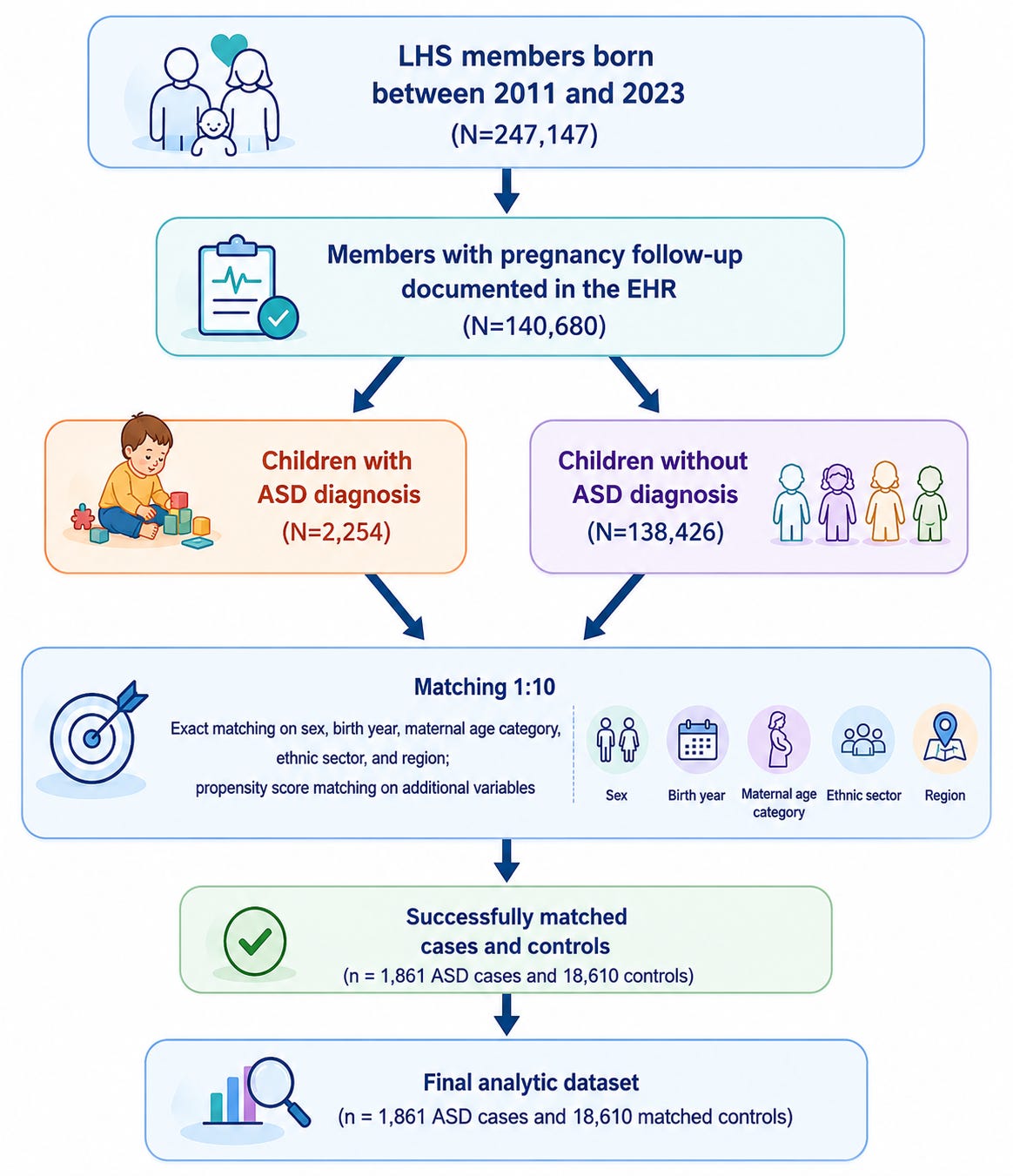
Children were carefully matched for major known ASD-associated factors, including sex, age, socioeconomic status, ethnic sector, maternal age, and geographic region, allowing us to investigate pregnancy-related factors associated with autism risk as rigorously as possible.
What emerged was a remarkably clear dose-response relationship between gestational age at birth and the risk of ASD.
The earlier a child was born, the greater the statistical risk of autism.
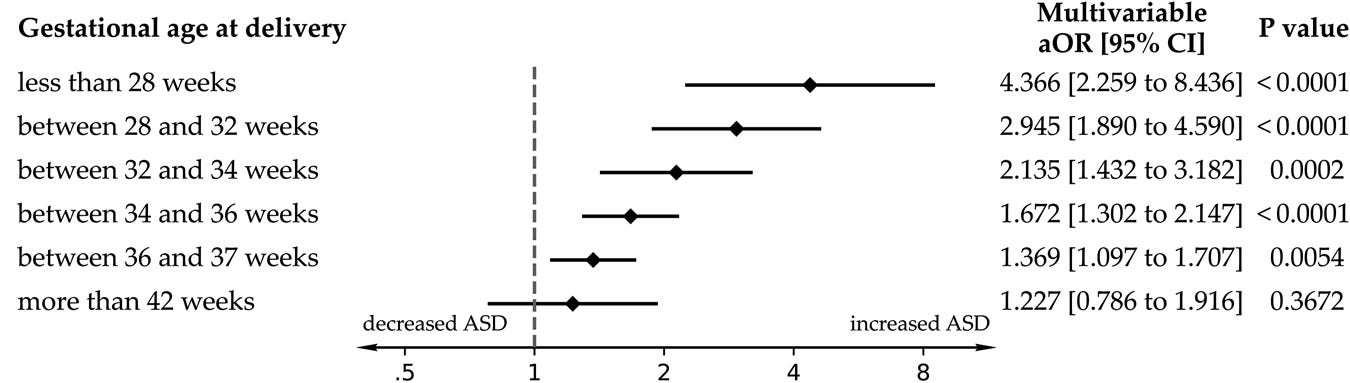
Compared with children born at term (37-42 weeks), the risk of subsequent ASD increased progressively with the degree of prematurity:
1.369-fold at 36 weeks
1.672-fold at 34-35 weeks
2.135-fold at 32-33 weeks
2.945-fold at 28-31 weeks
4.366-fold below 28 weeks
In epidemiology, this type of gradual biologic gradient is important.
When risk increases progressively with increasing exposure severity, it often suggests that the relationship may reflect underlying biology rather than mere statistical association.
At the same time, it is important to interpret these findings carefully and responsibly.
Most children born prematurely do not develop autism.
And many children diagnosed with ASD were born at full term.
These findings therefore should not be interpreted as deterministic predictions about individual children.
Rather, they suggest that prematurity may increase biologic vulnerability during a critical developmental window in at least some infants.
Why might this happen?
One possible explanation involves white matter development in the immature brain.
During late pregnancy, the fetal brain undergoes extraordinarily rapid development. Neural connectivity, synapse formation, myelination, immune regulation, and metabolic programming are all actively evolving during this period.
Premature birth exposes the developing brain to physiologic stresses during a particularly vulnerable stage.
Oxidative stress, neuroinflammation, altered cerebral oxygenation, mitochondrial dysfunction, and injury to immature oligodendrocytes may all potentially influence long-term neurodevelopmental trajectories.
Modern neonatology has dramatically improved survival among premature infants over recent decades, representing one of the major successes of modern medicine. Modern medical care must now strive to maximize the chances that prematurely born children achieve optimal long-term neurodevelopmental outcomes.
This is one reason why autism research today increasingly focuses not only on diagnosis, but also on early identification, developmental surveillance, and understanding modifiable risk factors whenever possible.
In this study, we analyzed the large-scale epidemiologic data accumulated within our electronic health records in an effort to better understand autism biology and identify population-level patterns that may help improve outcomes through:
early developmental surveillance,
recognition of children at elevated risk,
timing of interventions and support,
allocation of healthcare and educational resources,
and potentially, in the future, prevention strategies for some preventable forms of neurodevelopmental impairment.
Importantly, modern approaches to autism increasingly recognize that ASD is highly heterogeneous.
Some children have severe communication and developmental impairments.
Others function independently with relatively subtle social differences.
Some show accompanying intellectual disability, epilepsy, gastrointestinal symptoms, motor abnormalities, or immune-related conditions.
Others do not.
Increasingly, researchers are examining autism not simply as a behavioral diagnosis, but as a neurodevelopmental condition potentially influenced by early immune activation, inflammatory signaling, metabolic stress, genetic susceptibility, microbiome interactions, perinatal complications, and altered brain connectivity.
Large-scale epidemiology plays a critical role in this effort because many of these biologic signals are difficult to detect in smaller studies.
Patterns often become visible only when examining hundreds of thousands of longitudinal health records.
And in many areas of medicine, recognizing these patterns early has eventually led to major advances in prevention and treatment.
The hope is that by identifying earlier biologic signals, risk factors, and developmental trajectories, medicine may eventually become better at providing earlier support, more personalized interventions, and perhaps prevention for at least some forms of neurodevelopmental injury.
Autism remains deeply complex.
But modern epidemiology is beginning to reveal that neurodevelopment, immunity, inflammation, metabolism, and early-life physiology may be far more interconnected than medicine once believed.
And as increasingly large human datasets become available, some of these hidden biologic patterns are beginning to emerge.
References:
Prematurity and Autism: A Dose-Response Relationship Across Gestational Age
Journal of Perinatology (2026)
Israel A, Mimouni FB, Vinker S, Mendlovic
https://doi.org/10.1038/s41372-026-02632-x