

Migraine is often perceived as “just a headache.” But large-scale healthcare data are increasingly revealing that migraine may reflect broader biologic patterns involving metabolism, vascular physiology, and systemic health.
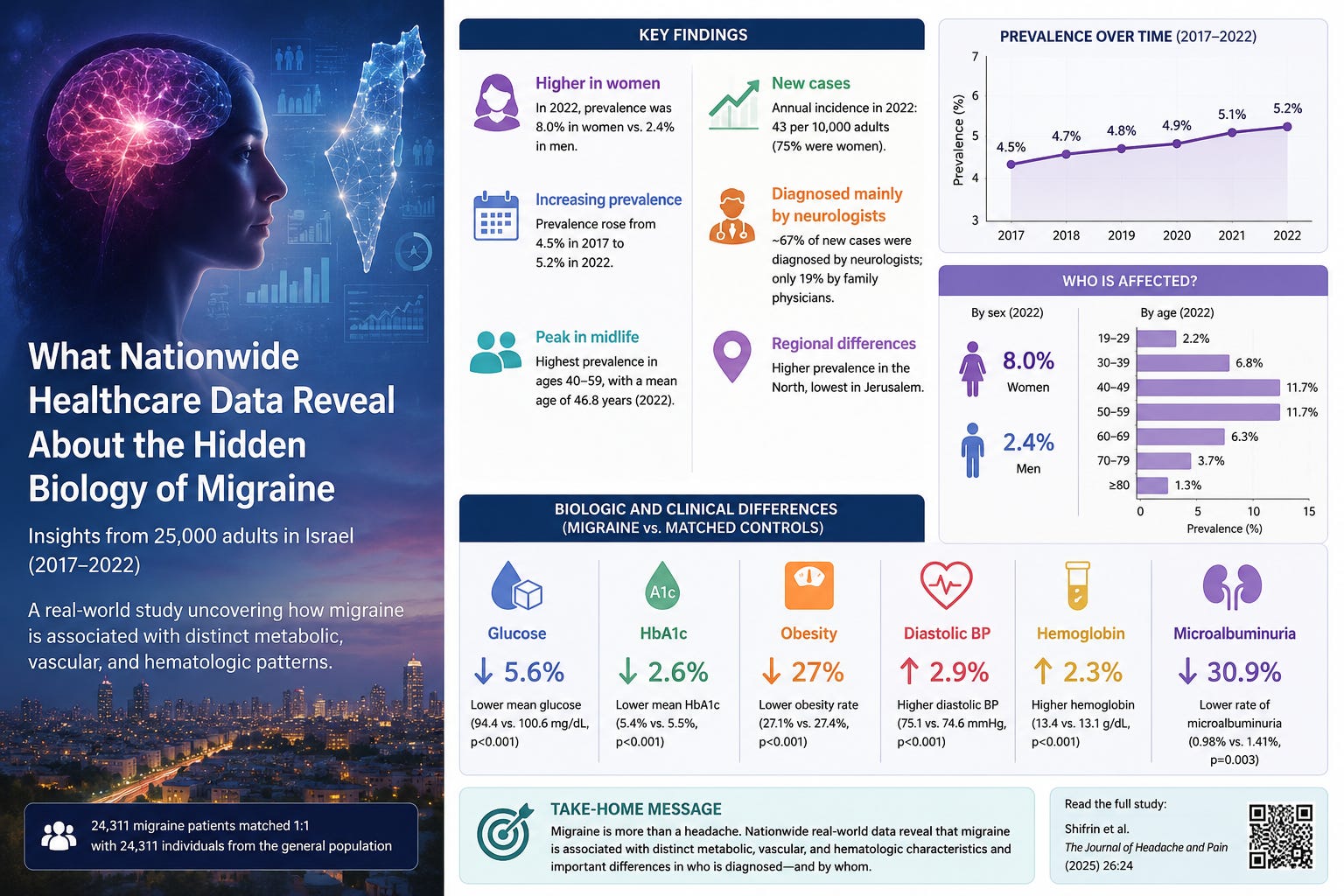
In a recent nationwide study published in The Journal of Headache and Pain, we analyzed electronic health records from one of Israel’s national healthcare organizations, covering nearly 25,000 adults with clinically significant migraine between 2017 and 2022. The study was based on real-world longitudinal medical data collected as part of routine healthcare, including physician diagnoses, laboratory tests, medication use, and physiologic measurements.
What emerged was not only a detailed picture of migraine epidemiology in Israel, but also a series of intriguing physiologic signals that may help shed light on migraine biology itself.
Migraine was far more common in women
One of the clearest findings was the major difference between men and women.
In 2022, clinically significant migraine affected approximately:
8.0% of women
2.4% of men
The highest prevalence was observed among women aged 40-59, where migraine affected nearly 1 in 9 women.
These findings are consistent with previous international studies, but the magnitude of the sex difference remains remarkable. Migraine is not simply slightly more common in women - it is dramatically more common.
The reasons are likely complex and involve hormonal, vascular, neurologic, and genetic factors that are still not fully understood.
Migraine patients showed unexpected metabolic differences
One of the most interesting aspects of the study was that migraine patients differed biologically from matched controls in several unexpected ways.
Compared to individuals without migraine, patients with clinically significant migraine tended to have:
lower blood glucose levels,
lower hemoglobin A1c levels,
lower rates of obesity,
lower rates of microalbuminuria,
slightly higher hemoglobin levels,
and slightly higher diastolic blood pressure.
At first glance, some of these findings may appear counterintuitive.
For example, migraine patients in our study were less likely to be obese and tended to have lower glucose and HbA1c levels than matched controls. This aligns with growing evidence suggesting that migraine and diabetes may have a complex inverse relationship in at least part of the population.
This does not mean that low glucose “causes” migraine, or that migraine somehow protects against diabetes. But it suggests that migraine biology may be connected to systemic metabolic pathways in ways that are not yet fully understood.
Migraine may therefore represent more than an isolated neurologic phenomenon. It may reflect broader physiologic states involving vascular regulation, energy metabolism, inflammation, autonomic function, and neurovascular signaling.
Real-world healthcare data can reveal hidden biologic patterns
One of the most powerful aspects of modern electronic health records is that they allow researchers to study diseases not only in small clinical cohorts, but across entire healthcare systems and over many years.
When carefully analyzed, these datasets can reveal subtle physiologic patterns that are often impossible to detect at the level of individual patients.
This is particularly important for chronic conditions such as migraine, fibromyalgia, ADHD, autoimmune diseases, schizophrenia, dementia, and metabolic disorders, where the biology is often multifactorial and difficult to fully capture in traditional reductionist models.
In many cases, large-scale longitudinal healthcare data allow us to identify unexpected associations first, and only later begin to understand the underlying biology.
Migraine may still be underdiagnosed
Another important finding was that most migraine diagnoses in our cohort were made by neurologists, while relatively few were diagnosed by family physicians.
This may suggest that clinically significant migraine remains under-recognized or underdiagnosed in routine medical care.
Migraine is one of the leading causes of disability worldwide, particularly during the most productive decades of life. Yet many patients continue to experience years of symptoms before receiving formal diagnosis or effective treatment.
Large healthcare databases may therefore help not only in understanding migraine biology, but also in identifying gaps in diagnosis and care at the population level.
The broader picture
At the Leumit Research Institute, our research spans multiple domains, including cancer epidemiology, healthy aging, and factors associated with neurodevelopmental, neuroinflammatory, and chronic conditions ranging from autism and ADHD to fibromyalgia, rheumatologic diseases, schizophrenia, and dementia.
Across these diverse fields, our research group has repeatedly observed that carefully analyzed longitudinal electronic health records can help unravel previously unrecognized biologic patterns and associations.
I believe that modern healthcare databases represent one of the most powerful tools currently available for uncovering hidden aspects of chronic disease biology and identifying factors that may help promote healthy aging and longevity at the population level.
References:
Epidemiology of clinically significant migraine in Israel: a retrospective database study.
Shifrin A, Domany E, Tirosh M, et al.
The Journal of Headache and Pain. 2025;26:24.
doi:10.1186/s10194-025-01961-0