

We know a lot about what happens in the brain: the progressive loss of dopamine-producing neurons, the accumulation of pathological proteins, the gradual appearance of tremor, rigidity, slowness of movement, constipation, sleep disturbance, loss of smell, depression, and cognitive changes.
But we still do not know why the process begins.
For decades, Parkinson’s disease has been understood as a complex disorder shaped by aging, genetics, environmental exposures, and possibly events occurring far from the brain — especially in the gut. One influential idea, proposed by Braak and others, is that in many patients the disease process may begin in the gastrointestinal tract or the olfactory system, and only later spread to the brain.
This raises a question that sounds simple, but may be important:
What if, in some patients, Parkinson’s disease is partly driven by a microbial toxin?
In a recent retrospective study that my colleagues and I published in Biomedicines, we examined this possibility by looking at an unexpected candidate: Clostridium tetani, the bacterium that causes tetanus.
Tetanus is usually thought of as an acute, dramatic disease caused by contamination of a wound. But C. tetani is also an environmental organism, its spores are highly resistant, and studies suggest that it may be present in the human gastrointestinal tract in some individuals.
The tetanus toxin is one of the most potent neurotoxins known. It can enter neurons, travel along nerves, and interfere with neurotransmission. In classic tetanus, this produces severe muscle rigidity and spasms. But we asked a different question: could chronic, low-level exposure to a related toxin-producing reservoir contribute to a much slower neurodegenerative process?
This is not a proven mechanism. It is a hypothesis.
But it is a hypothesis that can be tested.
What we studied
We used the electronic health records of Leumit Health Services, one of Israel’s four national health providers, covering more than two decades of medical data.
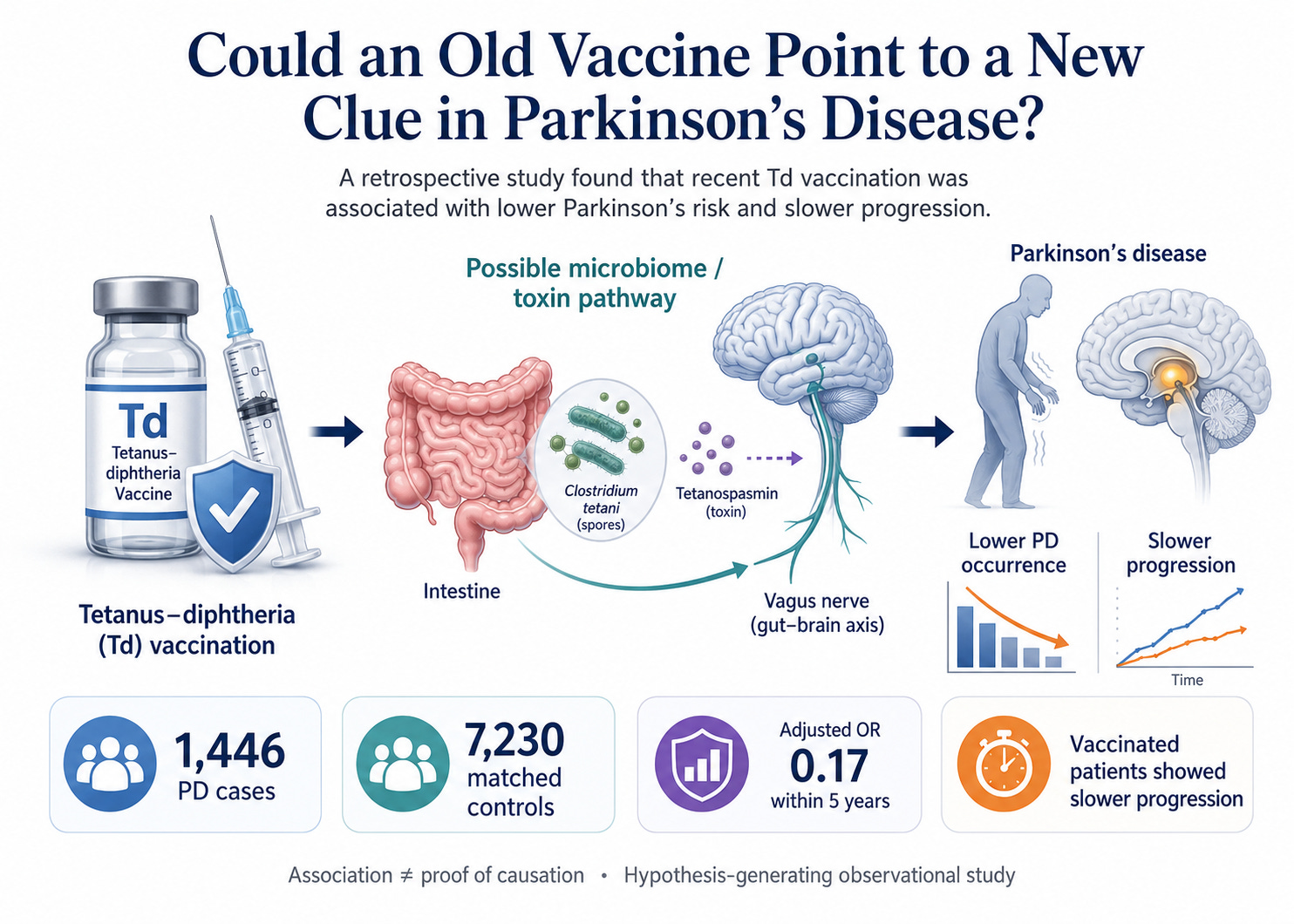
We identified 1,446 patients diagnosed with Parkinson’s disease between ages 45 and 75. For comparison, we selected 7,230 matched controls without Parkinson’s disease. The controls were matched by sex, socioeconomic status, year of enrollment in the health organization, and age as closely as possible.
We then looked backward in the medical records to see who had received a tetanus–diphtheria vaccine before the Parkinson’s diagnosis date.
The result was striking.
Only 1.52% of Parkinson’s patients had a recorded prior tetanus–diphtheria vaccination, compared with 2.99% of controls.
That corresponds to about a 50% lower odds of Parkinson’s disease among those with a prior recorded vaccination.
But the more interesting finding was not simply vaccinated versus unvaccinated.
It was timing.
The timing mattered
If a vaccine is truly protective, one would expect its effect to be strongest soon after vaccination and to weaken over time as immunity wanes.
That is exactly the pattern we observed.
The association with lower Parkinson’s risk was strongest in the first years after vaccination. Within five years after vaccination, the adjusted odds ratio for Parkinson’s disease was 0.17, meaning that Parkinson’s diagnoses were much less frequent in recently vaccinated individuals than in those without a recorded vaccination.
Between five and ten years after vaccination, the association was still present but weaker. After longer periods, the apparent protection faded.
This time-dependent pattern is important because it is harder to explain by a simple fixed difference between people who do or do not get vaccinated. It suggests that time since vaccination itself may matter.
Of course, observational data cannot prove causality. People who receive vaccines may differ from those who do not in many ways. They may be more active, more likely to seek care, more exposed to minor injuries, or different in ways that are not fully captured in the data.
But the timing pattern makes the finding more biologically interesting.
What about people who already had Parkinson’s disease?
We also asked whether vaccination was associated with the rate of Parkinson’s progression.
This is difficult to study in electronic health records because neurologic severity scales are not always recorded consistently. We therefore developed a machine-learning model that estimated disease severity from annual purchases of anti-Parkinson medications.
The idea is straightforward: as Parkinson’s disease progresses, patients typically require higher doses, more medications, or more complex treatment regimens. Medication patterns can therefore provide a proxy for disease severity over time.
Using this approach, we found that vaccinated Parkinson’s patients appeared to progress more slowly than those without a recorded vaccination.
In one analysis, the average disease severity of vaccinated patients in the seventh year of disease resembled that of unvaccinated patients in approximately the third year of disease.
Again, this does not prove that the vaccine slowed the disease. But it is consistent with the idea that immunity against tetanus toxin — or a related biological effect of vaccination — might influence disease progression.
The antibiotic clue
The study also produced another intriguing signal.
If C. tetani or related clostridial organisms are involved in Parkinson’s disease, then antimicrobial treatments affecting these bacteria might also be associated with disease severity.
We found that several antibiotics with activity relevant to clostridial organisms were associated with lower Parkinson’s severity. These included beta-lactam antibiotics, macrolides, and fluoroquinolones.
By contrast, clindamycin was associated with increased disease severity. This is notable because clindamycin is well known for disrupting the microbiome and promoting overgrowth of Clostridioides difficile, another clostridial organism.
We also observed opposite associations for two constipation treatments. Macrogol, an osmotic laxative, was associated with higher disease severity, while psyllium, a fiber supplement that may support a healthier gut microbiome, was associated with lower severity.
These findings should not be interpreted as treatment recommendations. Parkinson’s patients should not take antibiotics or change medications based on this study.
But as biological clues, these associations are compelling. They point repeatedly toward the gut, the microbiome, clostridial biology, and toxin-mediated neuronal injury.
A possible model
Taken together, the findings suggest a possible model:
In some individuals, C. tetani or related toxin-producing clostridial organisms may colonize sensitive sites such as the gut or the oral/nasal region.
From there, a neurotoxin could affect nearby neurons.
In the gut, this might contribute to autonomic dysfunction and constipation, both of which often appear years before the motor symptoms of Parkinson’s disease.
Through the vagus nerve or other neural pathways, the pathological process could eventually spread toward the central nervous system.
In the olfactory region, toxin exposure might contribute to smell loss, another common early feature of Parkinson’s disease.
Over many years, in genetically or environmentally susceptible individuals, this could contribute to the slow neurodegenerative process that eventually becomes clinically recognizable as Parkinson’s disease.
This model fits with several known features of Parkinson’s disease: the importance of the gut, early constipation, loss of smell, environmental risk factors, rural exposure, and the long prodromal period before diagnosis.
It also provides a testable explanation for why tetanus vaccination might be associated with lower risk and slower progression: vaccination generates antibodies that neutralize tetanus toxin.
What this study does — and does not — show
It is important to be cautious.
This was a retrospective observational study. It can identify associations, not prove cause and effect.
Vaccination records may be incomplete, especially for vaccines given before electronic records began or outside the health organization. Adult tetanus vaccination in Israel is often given after wounds rather than as a routine scheduled booster, which may create confounding. The vaccine used was usually a combined tetanus–diphtheria vaccine, so we cannot fully separate the tetanus component from the diphtheria component or from broader immune effects.
The number of vaccinated Parkinson’s patients was also small, so the findings need replication in larger datasets and other countries.
But the strength of the study is that several independent signals point in the same direction:
Recent tetanus–diphtheria vaccination was associated with lower Parkinson’s occurrence.
The association weakened as time since vaccination increased.
Vaccinated Parkinson’s patients appeared to progress more slowly.
Several antimicrobial and microbiome-related exposures showed associations consistent with a clostridial hypothesis.
This convergence does not prove the hypothesis, but it makes it worth testing.
Why this matters
Parkinson’s disease currently has no proven disease-preventing treatment and no cure that stops the underlying process.
If even a subset of Parkinson’s disease is influenced by a preventable or treatable microbial process, the implications would be enormous.
Tetanus vaccination is old, inexpensive, widely available, and already part of standard preventive medicine. Antibiotic or microbiome-based strategies would require much more caution, but they could be investigated in controlled trials.
The next step is not to change clinical practice immediately.
The next step is to test the hypothesis prospectively.
Could tetanus booster vaccination reduce Parkinson’s risk in older adults?
Could it slow progression in early Parkinson’s disease?
Could C. tetani or its toxin be detected more often in patients with Parkinson’s disease or in people with prodromal symptoms?
Could microbiome interventions reduce toxin-producing clostridial reservoirs?
These are practical questions. They can be studied.
A new way to look at an old disease
Many major discoveries in medicine began with an unexpected association.
The idea that ulcers were caused by bacteria was once considered unlikely. The link between viruses and cancer was once controversial. The role of the microbiome in systemic disease would have sounded speculative not long ago.
Parkinson’s disease may not have one single cause. It is probably a syndrome with multiple pathways leading to a similar clinical picture.
But our findings suggest that, in at least some patients, an old bacterium and an old vaccine may point toward a new biological mechanism.
That does not mean the case is closed.
It means there is now a clue worth following.
Read the peer-reviewed study in Biomedicines:
https://www.mdpi.com/2227-9059/12/12/2687